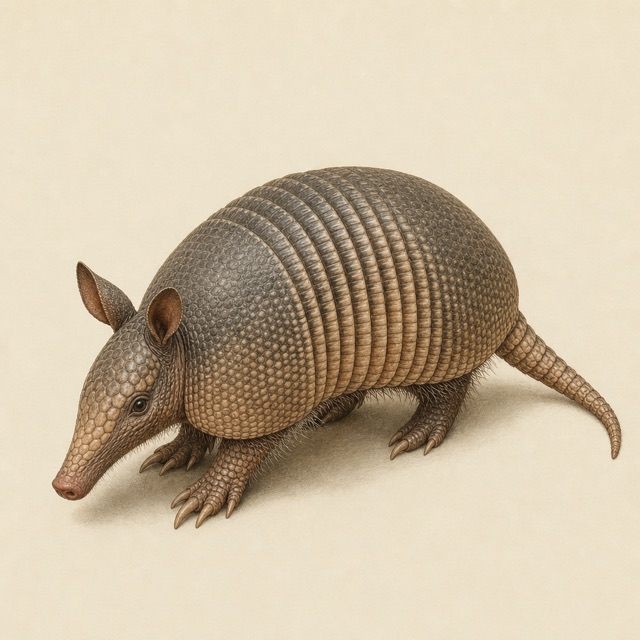
Armadillos are prolific diggers that can destroy a manicured lawn overnight, leaving behind dozens of small holes as they root for grubs and insects. Their burrowing also undermines foundations, driveways, and utility lines, making them a costly pest for homeowners across the southern and central United States.
The nine-banded armadillo is unmistakable with its bony armored shell consisting of nine movable bands across the midsection. They have a long pointed snout, large ears, and a tapering armored tail. Their front claws are powerful and designed for digging, capable of excavating burrows up to 15 feet long.
Similar Pests
No other North American animal closely resembles an armadillo. Their distinctive armored shell makes misidentification virtually impossible. Their digging damage may be confused with skunk foraging, but armadillo holes tend to be more numerous, shallower, and concentrated in larger areas.
Signs of Infestation
- •Numerous shallow, cone-shaped holes 3 to 5 inches deep scattered across the lawn
- •Large burrow entrances 7 to 10 inches in diameter near foundations, tree roots, or rock piles
- •Uprooted mulch and disturbed flower beds where armadillos have rooted for insects
- •Tracks showing four elongated toes on front feet and five on hind feet with scratch marks
Key Inspection Areas
- •Along foundation walls, under concrete slabs and porches
- •Under dense shrubs, woodpiles, and low-growing ground cover
- •Near flower beds, garden areas, and mulched landscape borders
- •Along fence lines, creek banks, and drainage ditches
When to Inspect
Inspect at dusk or after dark when armadillos emerge to forage. They have poor eyesight and can often be approached with a flashlight. Daytime inspections should focus on locating burrow entrances and mapping the extent of lawn damage.
Inspection Tools
Flashlight for nighttime observation, a probe rod to check burrow depth and direction, and garden flags to mark burrow locations and damaged zones
Map burrow locations and travel routes
Walk your property to identify all burrow entrances, which are typically 7 to 10 inches in diameter and located under structures, tree roots, or dense vegetation. Armadillos follow consistent paths between their burrows and foraging areas. Look for worn trails through grass or mulch to plan trap placement.
Reduce the food source
Apply beneficial nematodes to your lawn according to package directions to kill grubs and soil-dwelling insects that armadillos feed on. Water the treatment in thoroughly. This reduces the armadillo's primary motivation for digging in your yard and makes your property less attractive compared to neighboring areas.
Set live traps along travel routes
Place large cage traps (at least 12 by 10 by 32 inches) directly in armadillo travel paths or immediately in front of active burrow entrances. Use wooden boards or garden fencing to create funnel-shaped wings on either side of the trap to guide the armadillo inside. Armadillos rarely respond to bait, so trap placement on travel paths is critical.
Apply in-ground barriers around vulnerable areas
Install quarter-inch hardware cloth or welded wire mesh fencing around gardens, foundations, and other areas needing protection. Bury the fence at least 18 inches deep with the bottom 6 inches angled outward to prevent digging under. The above-ground portion should stand at least 24 inches high.
Apply repellent treatments to foraging zones
Spread castor oil-based granular repellent across lawn areas where armadillos have been digging. Water it in lightly to help the castor oil penetrate the soil. This creates an unpleasant taste and smell in the soil that discourages further foraging. Reapply every 30 days and after heavy rain.
Fill burrows after confirmed vacancy
Once you have trapped or excluded the armadillo, confirm burrows are empty by loosely packing the entrance with newspaper and checking after 3 days. If undisturbed, fill burrows with a mixture of gravel and soil, compacting firmly. Unfilled burrows can attract new armadillos, snakes, or other wildlife.
Repair lawn damage and maintain deterrents
Fill foraging holes with topsoil, tamp down, and reseed or re-sod damaged areas. Continue repellent applications monthly through the active season. Monitor for new digging weekly, especially after rain, and reset traps immediately if new activity appears. Consistent maintenance prevents re-infestation from neighboring armadillo populations.
- 1Apply beneficial nematodes or milky spore to your lawn to reduce grub populations that attract armadillos
- 2Install a buried fence of quarter-inch hardware cloth extending 18 inches underground and angling outward in an L-shape around gardens and foundations
- 3Remove dense ground cover, brush piles, and rock piles that provide daytime hiding spots
- 4Keep mulch layers thin (under 2 inches) to reduce insect habitat in garden beds
- 5Maintain a well-drained yard, as armadillos prefer moist soil that is easier to dig
- 6Apply granular castor oil-based repellent to lawn areas where foraging damage is concentrated
Seasonal Note
Armadillo activity increases after rainfall when soil is soft and grubs are near the surface. Focus prevention and trapping efforts during wet spring months when armadillos are most actively foraging. In areas with mild winters, armadillos remain active year-round.
Do armadillos carry leprosy?
Nine-banded armadillos are the only animal other than humans known to naturally carry Mycobacterium leprae, the bacterium that causes Hansen's disease (leprosy). While transmission to humans is rare and requires prolonged direct contact, you should never handle armadillos with bare hands. The actual risk from yard encounters is extremely low.
What is the best bait for armadillo traps?
Armadillos have a poor sense of smell relative to their reliance on rooting behavior, so traditional baits are largely ineffective. Trap placement is far more important than bait. Position traps directly in travel paths or at burrow entrances, using wing barriers to funnel the armadillo into the trap.
Will armadillos damage my house foundation?
Yes. Armadillo burrows can extend up to 15 feet and may run directly under foundations, driveways, and sidewalks. Over time, this undermining can cause settling, cracking, and structural movement. If you find burrows near your foundation, address the problem promptly and consult a foundation specialist if damage has occurred.
Are armadillos active during the day?
Armadillos are primarily nocturnal and crepuscular, meaning they are most active at night and around dusk and dawn. However, during cooler months they may shift to daytime foraging to take advantage of warmer soil temperatures. Daytime activity alone does not indicate illness.
Can armadillos climb fences?
Armadillos are surprisingly capable climbers and can scale fences up to 3 to 4 feet high. However, their primary method of bypassing fences is digging underneath them. An effective armadillo fence must be buried at least 18 inches underground with an outward-angled footer to prevent burrowing under.
Quick Facts
- Size
- 24 to 32 inches long including tail; 8 to 17 pounds
- Color
- Dark brown to yellowish-brown armored shell (carapace) with lighter underside and sparse coarse hairs
- Habitat
- Wooded areas adjacent to open fields, suburban yards with moist soil, gardens, and areas near creeks and streams
- Active Season
- Year-round in warm climates; most active from spring through fall, primarily foraging at night
Danger Level: Low
This pest is primarily a nuisance but can be eliminated with DIY methods.