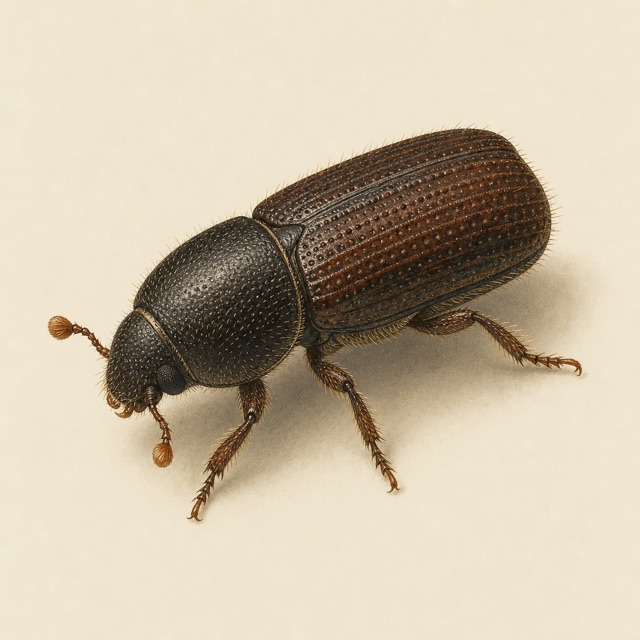
Bark beetles are devastating tree pests responsible for killing millions of acres of forest across North America each year. These tiny insects bore through bark to feed and reproduce in the cambium layer, cutting off a tree's nutrient supply and often introducing deadly fungal pathogens. Homeowners with valued landscape trees need to act quickly at the first signs of bark beetle attack.
Bark beetles are tiny, cylindrical insects with hard, dark-colored exoskeletons. Their heads are often partially concealed beneath the pronotum, and many species have a concave or scooped rear end used to push frass from tunnels. Larvae are white, legless grubs found in winding galleries beneath the bark.
Similar Pests
Sometimes confused with ambrosia beetles, which bore deeper into sapwood and produce distinctive toothpick-like frass tubes. Wood borers (longhorn beetles) are much larger and leave larger exit holes. Bark beetle entry holes are tiny, about the size of a pencil lead.
Signs of Infestation
- •Small, round entry holes in tree bark with reddish-brown boring dust
- •Pitch tubes -- masses of resin mixed with frass on the bark surface
- •Fading, yellowing, or reddening of tree crown (top-down dieback)
- •Bark that flakes off easily, revealing serpentine galleries underneath
Key Inspection Areas
- •Trunks and major branches of pine, spruce, fir, and elm trees
- •Recently stressed trees near construction zones or drought-affected areas
- •Freshly cut logs, stumps, and stacked firewood
- •Windfall trees and storm-damaged limbs
When to Inspect
Inspect in spring when adults begin flying, and again in late summer during second-generation emergence. Check stressed trees year-round.
Inspection Tools
Binoculars for crown inspection, bark knife or hatchet for peeling bark samples, hand lens for examining entry holes
Identify the Bark Beetle Species
Determine which bark beetle species is present, as treatment strategies vary. Peel a small section of bark from an affected area and photograph the gallery pattern. Ips beetles create star-shaped patterns, southern pine beetles create S-shaped galleries, and mountain pine beetles create vertical galleries. Contact your local cooperative extension service for species identification.
Assess Tree Health and Infestation Stage
Examine the tree crown for color changes. Green crowns with few entry holes indicate an early attack that may be survivable. Yellow, red, or brown crowns with extensive boring dust indicate the tree is likely beyond saving. Check for pitch tubes on the trunk -- abundant white pitch tubes suggest the tree is fighting back successfully.
Remove Heavily Infested Trees
Trees with widespread crown fading and extensive gallery development should be removed promptly. Fell, debark, chip, or burn infested trees before the next generation of beetles emerges. Leaving dead infested trees standing creates a reservoir of beetles that will attack neighboring healthy trees.
Apply Protective Insecticide to Nearby Trees
Spray the trunks of adjacent high-value trees with a registered bark beetle insecticide containing carbaryl (Sevin), bifenthrin, or permethrin. Thoroughly wet the entire trunk from ground level to the base of the main branches. This creates a lethal barrier that kills beetles on contact as they attempt to bore in.
Manage Infested Wood Properly
Chip, debark, solarize, or burn all infested wood material. If storing firewood, cover tightly with clear plastic sheeting in direct sun to solarize and kill developing larvae. Never transport infested firewood to new locations, as this is a primary means of spreading bark beetle populations.
Boost Tree Defenses
Water stressed trees deeply and consistently -- apply 10 gallons per inch of trunk diameter monthly during dry periods. Avoid fertilizing heavily, as rapid soft growth can attract beetles. Mulch around the base of trees with 3-4 inches of organic material to conserve soil moisture and moderate root temperature.
Monitor Continuously
Install pheromone traps to detect bark beetle activity in your area. Inspect valued trees monthly during flight season for new entry holes, boring dust, or pitch tubes. Re-apply preventive trunk sprays every 6-12 months during periods of high bark beetle pressure. Consider consulting a certified arborist for an ongoing management plan.
- 1Keep trees healthy with proper watering, especially during drought -- deeply water landscape trees monthly in dry periods
- 2Avoid soil compaction and root damage during construction near valued trees
- 3Prune dead and dying branches promptly, but avoid pruning during beetle flight season (spring/summer)
- 4Remove and destroy infested trees and freshly cut logs before beetles emerge
- 5Apply preventive insecticide sprays (carbaryl or bifenthrin) to high-value trees before beetle flight season
- 6Maintain proper tree spacing to reduce competition for water and nutrients
Seasonal Note
Preventive trunk sprays must be applied before beetle flight begins, typically by early April in most regions. Water trees deeply throughout summer and fall to maintain vigor.
Can a tree survive a bark beetle attack?
Healthy, vigorous trees can often repel bark beetle attacks by flooding entry holes with resin (pitch). However, once beetles successfully colonize a tree and gallery development is extensive, survival is unlikely. Early detection and maintaining tree health are key to survival.
Do bark beetles attack healthy trees?
Under normal conditions, bark beetles primarily target stressed, weakened, or dying trees. However, during population outbreaks driven by drought or warm winters, beetle numbers can overwhelm even healthy trees' natural defenses through mass attack.
How fast do bark beetles kill a tree?
Bark beetles can kill a tree in as little as 2-4 weeks during a mass attack, though it may take several months for the crown to fully change color. The actual death occurs when beetle galleries and associated fungi girdle the cambium layer, cutting off water and nutrient transport.
Should I spray my trees for bark beetles preventively?
Preventive spraying is recommended only for high-value landscape trees in areas with active bark beetle populations. Apply registered insecticides to the trunk before beetle flight season begins. Spraying is not practical or necessary for large forested areas.
Does firewood spread bark beetles?
Yes, transporting infested firewood is one of the primary ways bark beetles spread to new areas. Always use firewood locally -- buy it where you burn it. If you suspect firewood is infested, cover it with clear plastic in direct sunlight for several weeks to kill developing beetles.
Quick Facts
- Size
- 1/16 to 1/4 inch (2-6 mm)
- Color
- Dark brown to black, cylindrical body
- Habitat
- Beneath the bark of coniferous and hardwood trees, especially stressed or weakened specimens
- Active Season
- Spring through fall (peak flight activity April through September)
Danger Level: Medium
This pest can cause health issues or property damage if left untreated.