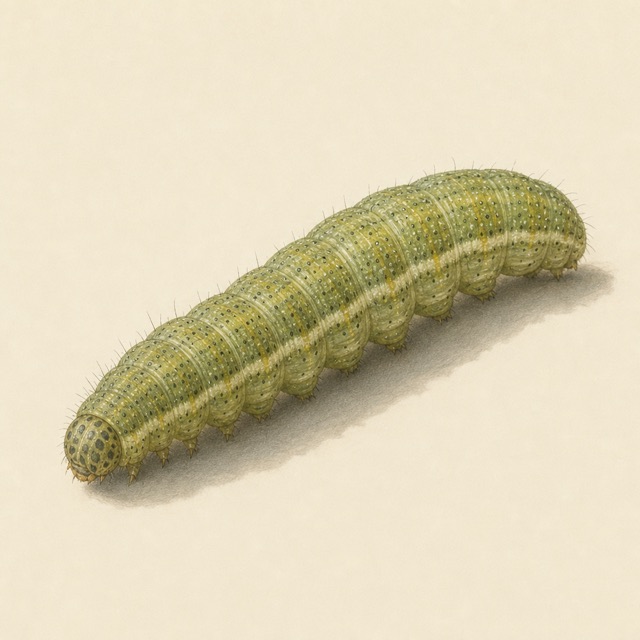
Cabbage worms are the larvae of the common white cabbage butterfly and are among the most persistent pests of brassica crops worldwide. These velvety green caterpillars chew large holes through the leaves of cabbage, broccoli, kale, cauliflower, and Brussels sprouts, often hiding deep within heads where damage goes unnoticed until harvest. Their prolific reproduction and voracious appetite make consistent management essential for any brassica grower.
Imported cabbage worm larvae are smooth, velvety green caterpillars about one inch long with a faint yellow or orange stripe running along the back. They move slowly and are well camouflaged against brassica leaves. The adult is the familiar small white butterfly with one or two black spots on each forewing that flutters around gardens in spring and summer.
Similar Pests
Cabbage loopers (Trichoplusia ni) are similar green caterpillars but move with a distinctive looping motion and lack the velvety texture. Diamondback moth larvae are smaller and more active. Cross-striped cabbageworms have distinctive horizontal black and yellow bands.
Signs of Infestation
- •Irregular holes chewed through brassica leaves
- •Green frass (droppings) pellets on leaves and in leaf folds
- •White butterflies hovering and landing on brassica plants to lay eggs
- •Small, yellowish, bullet-shaped eggs laid singly on leaf undersides
Key Inspection Areas
- •On the undersides of brassica leaves where eggs are laid singly
- •Deep within cabbage heads and broccoli florets where caterpillars hide
- •Along the midrib and veins of kale and collard leaves
- •On any brassica family plant including ornamental varieties
When to Inspect
Inspect plants twice weekly from spring through fall. Watch for white butterflies visiting your garden as an early warning sign. Check the undersides of lower leaves first, then work inward on heading varieties.
Inspection Tools
Hand lens for spotting eggs, garden hose with spray nozzle for dislodging caterpillars, row cover material for exclusion
Monitor for white butterfly activity
Watch your garden for the characteristic small white butterflies with black wing spots visiting brassica plants. When you see them hovering and landing repeatedly, they are laying eggs. This is your cue to begin active control measures within three to five days before caterpillars hatch.
Install row covers for physical exclusion
Drape lightweight floating row covers over brassica beds and secure the edges with soil, boards, or landscape staples. This prevents adult butterflies from reaching plants to lay eggs. Row covers also provide light frost protection and can remain in place throughout the growing season since brassicas do not require insect pollination.
Hand-pick caterpillars and eggs
Inspect plants two to three times per week, carefully checking leaf undersides for tiny yellow eggs and small green caterpillars. Crush eggs between your fingers and drop caterpillars into soapy water. For heading crops, peel back outer leaves to check inner surfaces.
Apply Bt (Bacillus thuringiensis)
Spray Bt var. kurstaki on all plant surfaces, focusing on leaf undersides where young caterpillars feed. Bt must be ingested to work and is most effective on young caterpillars. Apply every five to seven days and after rain. Bt is completely safe for beneficial insects, humans, and animals.
Use spinosad for persistent infestations
Apply OMRI-listed spinosad spray as a complement or alternative to Bt for heavy infestations. Spinosad provides broader-spectrum caterpillar control and remains active for up to a week. Spray in the evening to minimize exposure to foraging pollinators.
Deploy decoy butterflies
Place white butterfly decoys (available commercially or made from white plastic or paper) on stakes throughout your brassica beds. Cabbage white butterflies are territorial and may avoid areas where they see other butterflies already present, reducing egg-laying.
Attract and release parasitic wasps
Plant small-flowered herbs like dill, fennel, and cilantro to attract Cotesia glomerata and other parasitic wasps that lay their eggs inside cabbage worm caterpillars. You can also purchase Trichogramma wasps to release, which parasitize butterfly eggs before caterpillars ever hatch.
- 1Install floating row covers over brassica beds at planting time to exclude adult butterflies
- 2Plant brassicas with strong-scented companion plants like thyme, sage, rosemary, and dill
- 3Interplant red or purple brassica varieties which are less attractive to egg-laying butterflies
- 4Remove brassica crop debris immediately after harvest to prevent population buildup
- 5Encourage beneficial insects by planting small-flowered herbs and wildflowers nearby
- 6Stagger brassica plantings to spread risk and reduce catastrophic losses from a single generation
Seasonal Note
Cabbage butterflies can produce three to five overlapping generations per season in most climates. Spring and fall crops often face the heaviest pressure. Early spring row covering before the first butterflies appear is the most reliable prevention strategy.
Are cabbage worms harmful if accidentally eaten?
Accidentally eating a cabbage worm is not harmful to humans. While unappetizing, they are not toxic or parasitic. Soaking harvested brassicas in cold salt water for 15 to 30 minutes will cause any hidden caterpillars to float out.
Do cabbage worms only eat cabbage?
No, cabbage worms feed on all brassica family plants including broccoli, kale, cauliflower, Brussels sprouts, collards, kohlrabi, turnips, and radishes. They also attack ornamental brassicas and some related plants like nasturtiums.
How do I tell cabbage worms from cabbage loopers?
Cabbage worms have a velvety texture, move with a standard crawling motion, and have a faint yellow stripe. Cabbage loopers are smoother, move with a distinctive arching or looping motion (like an inchworm), and are typically a brighter green with white side stripes.
Can cabbage worms survive winter?
Cabbage worms overwinter as pupae (chrysalises) attached to plant stems, fences, building walls, and debris near the garden. They do not survive as caterpillars or butterflies through cold winters. Cleaning up garden debris in fall removes overwintering sites.
Do purple or red cabbages resist cabbage worms?
Red and purple brassica varieties are somewhat less attractive to egg-laying cabbage white butterflies compared to green varieties. The caterpillars are also more visible on dark leaves, making them easier to spot and remove. However, purple varieties are not immune to attack.
Quick Facts
- Size
- 1 to 1.25 inches long when mature
- Color
- Velvety green with a faint yellow stripe along the back; adult butterfly is white with black wing spots
- Habitat
- Gardens and farms growing brassica crops (cabbage, broccoli, kale, cauliflower, collards)
- Active Season
- Spring through fall, multiple overlapping generations per year
Danger Level: Low
This pest is primarily a nuisance but can be eliminated with DIY methods.