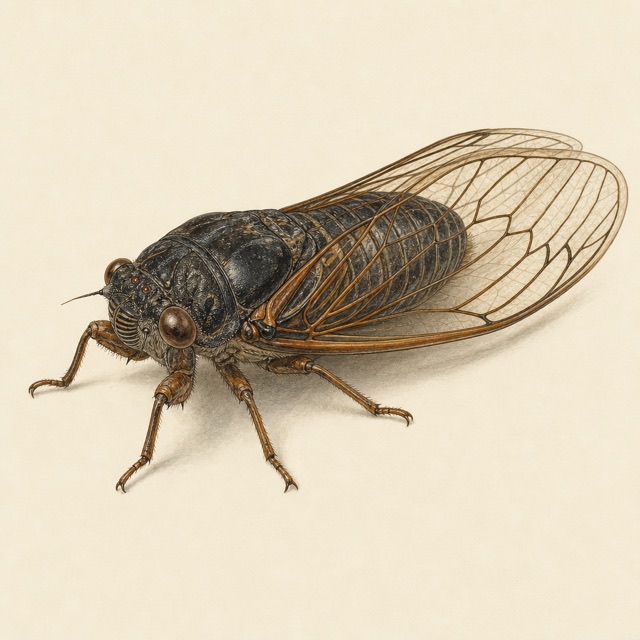
Cicadas are large, loud insects famous for their deafening choruses that can reach 100 decibels during emergence events. While periodical cicadas (appearing every 13 or 17 years) make dramatic headlines, annual cicadas emerge every summer across most of North America. Though cicadas are largely harmless to humans and established trees, their egg-laying behavior can damage young trees and ornamental plantings.
Cicadas are large, robust insects with wide-set, prominent compound eyes, clear membranous wings held roof-like over the body, and short antennae. They are best known for the loud buzzing or clicking songs produced by males using specialized tymbal organs on their abdomens. Nymphs are brown, wingless, and found underground attached to tree roots.
Similar Pests
Sometimes confused with locusts (which are grasshoppers) despite being completely unrelated. Cicadas do not swarm or consume crops like locusts. Cicada killer wasps are sometimes mistaken for cicadas themselves -- these are large wasps that hunt cicadas. Cicada exoskeletons (shed nymph skins) on tree trunks are often found before adults are seen.
Signs of Infestation
- •Loud buzzing or clicking sounds from treetops, especially on hot afternoons
- •Brown nymph exoskeletons (shed skins) clinging to tree trunks, fences, and walls
- •Small slits in young tree branches where females have laid eggs
- •Dime-sized emergence holes in soil beneath trees
Key Inspection Areas
- •Deciduous tree canopies where males sing and mating occurs
- •Branches and twigs of young trees and shrubs for egg-laying slits (flagging)
- •Soil beneath trees for emergence holes (about 1/2 inch diameter)
- •Tree trunks, fence posts, and building walls for shed nymph skins
When to Inspect
Inspect in late May through June during periodical cicada years, and June through August for annual cicadas. Look for emergence holes and shed skins as the first signs of activity.
Inspection Tools
No specialized tools needed; binoculars helpful for observing canopy activity
Determine the Cicada Type
Identify whether you are dealing with annual cicadas (green/black, every summer) or periodical cicadas (black with red eyes, 13- or 17-year cycle). Annual cicadas appear in low to moderate numbers each year and cause minimal damage. Periodical cicadas emerge in massive numbers that can overwhelm young trees. Check USDA brood maps for periodical cicada predictions in your area.
Protect Young Trees With Netting
Cover young, newly planted, or high-value small trees with fine mesh netting or tulle fabric before cicadas emerge. Use netting with openings no larger than 1/4 inch and secure it around the trunk base with twine or zip ties. This prevents female cicadas from accessing branches to lay eggs. Remove netting after the emergence period ends (typically 4-6 weeks).
Prune Damaged Branch Tips
After the cicada season, inspect young trees for flagging -- brown, wilted branch tips caused by egg-laying slits. Prune damaged branch tips back to healthy wood using clean, sharp pruners. This natural pruning actually benefits many trees and is sometimes called 'nature's pruning.' Dispose of pruned branches away from valued trees.
Manage Noise Concerns
During heavy emergence events, cicada choruses can exceed 90-100 decibels. If noise is bothersome, keep windows closed during peak calling periods (typically hot afternoons). White noise machines or fans can help mask the sound indoors. The intense noise period typically lasts only 3-4 weeks.
Clean Up Emergence Areas
After the emergence period, cicada bodies and shed skins may accumulate in large numbers. Rake up dead cicadas from patios, sidewalks, and garden beds to prevent odor as they decompose. Composting dead cicadas is beneficial -- they are rich in nitrogen and return nutrients to the soil. Wash down surfaces with a hose to remove residue.
Avoid Unnecessary Chemical Treatments
Insecticide spraying for cicadas is generally ineffective, wasteful, and harmful to beneficial insects, birds, and the environment. Cicada populations are too large and mobile for chemical control to be practical. The ecological damage from broad-spectrum spraying far outweighs any benefit. Focus on physical protection of valued young trees instead.
Support Tree Recovery and Enjoy the Event
Water and lightly fertilize young trees that sustained egg-laying damage. Established trees need no special care. Consider embracing the cicada emergence as a remarkable natural phenomenon -- they are a food bonanza for birds, small mammals, and fish. Cicadas do not bite, sting, or carry diseases, and their time above ground is brief.
- 1Delay planting new trees and shrubs until after a known periodical cicada emergence has ended
- 2Cover young or newly planted trees with fine mesh netting (1/4 inch or smaller) before emergence begins
- 3Secure netting around the trunk base to prevent cicadas from accessing branches
- 4Avoid pruning trees during cicada season, as fresh cuts attract egg-laying females
- 5Water young trees consistently to help them recover from any egg-laying branch damage
- 6Accept that established, healthy trees will tolerate cicada activity without lasting harm
Seasonal Note
If a periodical cicada emergence (Brood emergence) is predicted for your area, install protective netting on vulnerable young trees 2-3 weeks before expected emergence, typically by early May in most regions.
Do cicadas bite or sting?
No, cicadas do not bite or sting. They lack the mouthparts for biting and have no stinger. Their piercing mouthparts are designed solely for sucking tree sap. Cicadas are completely harmless to humans and pets, though they may occasionally land on people, which can be startling.
Will cicadas damage my mature trees?
Mature, healthy trees easily withstand cicada activity, even during massive periodical emergences. The egg-laying slits in branch tips cause minor flagging (browning of branch tips) that acts as a natural pruning and does not threaten tree health. Only young or newly planted trees may need protection.
How long do cicadas last?
Individual adult cicadas live for about 4-6 weeks above ground. Annual cicada activity spans June through September with overlapping generations. Periodical cicada emergences are intense but brief -- adults are present for about 4-6 weeks before dying off. The noisy peak lasts about 2-3 weeks.
Can I eat cicadas?
Yes, cicadas are edible and considered a delicacy in many cultures worldwide. They are high in protein, low in fat, and have a mild, nutty flavor. Newly emerged adults (teneral stage, still white) are considered most tender. People with shellfish allergies should avoid cicadas, as they share similar proteins.
Why are cicadas so loud?
Male cicadas produce their loud calls using specialized structures called tymbals -- ribbed membranes on the sides of the abdomen that vibrate rapidly to produce sound. The hollow abdomen acts as a resonating chamber, amplifying the sound. Males call to attract females, and synchronized choruses can reach 100 decibels or more.
Quick Facts
- Size
- 1 to 2 inches long with wingspan up to 3 inches
- Color
- Annual cicadas are green and black; periodical cicadas are black with red eyes and orange wing veins
- Habitat
- Deciduous trees and shrubs; nymphs live underground feeding on tree roots
- Active Season
- Annual cicadas emerge June through September; periodical cicadas emerge May through June in specific years
Danger Level: Low
This pest is primarily a nuisance but can be eliminated with DIY methods.