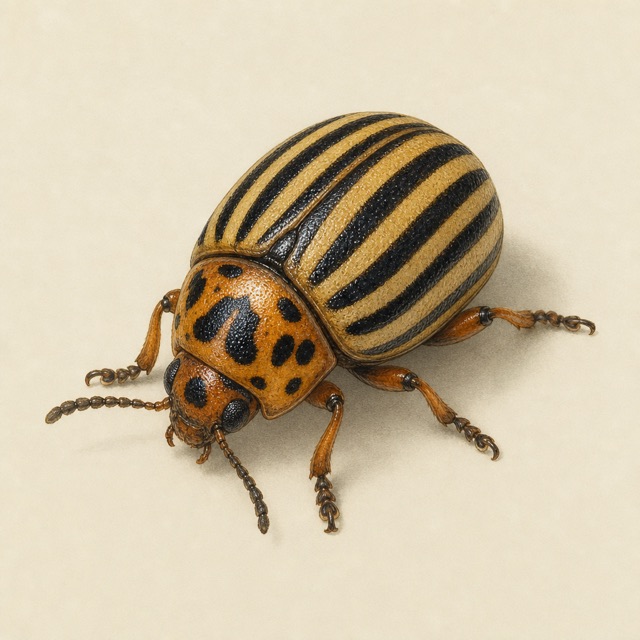
The Colorado potato beetle is one of the most economically important insect pests worldwide and a notorious headache for home gardeners growing potatoes, eggplant, and tomatoes. These striking yellow-and-black-striped beetles have developed resistance to nearly every class of chemical insecticide, making integrated management approaches essential. Both adults and larvae are voracious defoliators that can completely strip potato plants if left unchecked.
Adult Colorado potato beetles are round, convex beetles about three-eighths of an inch long with a distinctive pattern of ten alternating black and yellow stripes on their wing covers. Larvae are plump, reddish-orange grubs with rows of black spots along their sides and a black head. Egg masses are bright orange-yellow clusters on leaf undersides.
Similar Pests
The false potato beetle (Leptinotarsa juncta) looks similar but has alternating brown and white stripes and feeds primarily on horsenettle rather than potatoes. Three-lined potato beetles are smaller with fewer stripes. Confirm identification by checking for the characteristic ten black stripes.
Signs of Infestation
- •Skeletonized or completely defoliated potato and eggplant leaves
- •Bright orange-yellow egg clusters on leaf undersides
- •Plump reddish-orange larvae with black spots feeding in groups
- •Adults with distinctive yellow and black striped wing covers on foliage
Key Inspection Areas
- •On potato and eggplant leaf surfaces, both upper and lower sides
- •At the base of emerging potato plants in spring where overwintered adults first appear
- •Under leaf debris and mulch near nightshade crop areas
- •On weedy nightshade plants near the garden that serve as alternate hosts
When to Inspect
Begin inspecting as soon as potato shoots emerge in spring. Check plants every two to three days for adults, egg masses, and larvae. The critical damage window is during tuber formation when defoliation most impacts yield.
Inspection Tools
Garden gloves for hand-picking, bucket of soapy water for disposal, hand lens for egg identification, mulch straw for barrier management
Scout for overwintered adults in spring
As potato plants emerge, check daily for adult beetles walking on plants or soil surface. Overwintered adults are the founders of the season's population. Removing them before they lay eggs prevents the exponential growth of the first larval generation.
Hand-pick adults, larvae, and egg masses
Remove adult beetles, larval clusters, and bright orange egg masses by hand. Drop adults and larvae into a bucket of soapy water. Crush egg masses on the leaves or remove the leaf section. For a typical home garden, this is the most effective primary control.
Apply Bt var. tenebrionis for larvae
Spray Bt var. tenebrionis (also called Bt var. san diego, sold as Novodor) when larvae are small (first and second instar). This biological insecticide targets beetle larvae specifically. Thorough leaf coverage is essential and reapplication every five to seven days is needed.
Use spinosad for heavy larval infestations
Apply OMRI-listed spinosad spray to potato foliage when large numbers of larvae are present. Spinosad is effective against both larvae and adults. Spray in evening to protect pollinators and reapply after rain. Rotate with Bt to delay resistance development.
Apply neem oil as a growth regulator
Spray azadirachtin-based neem oil on plants to disrupt beetle feeding and larval development. Neem acts as an antifeedant and insect growth regulator, reducing the ability of larvae to molt and mature. Apply every seven days for best results.
Use straw mulch to support predators
Apply four to six inches of straw mulch around potato plants. Deep mulch provides habitat for ground beetles, spiders, and other predators that feed on Colorado potato beetle larvae and eggs. Mulched plots consistently show lower beetle populations than bare-soil plots.
Implement trench trapping in spring
Dig a narrow trench 12 inches deep with steep sides around the potato bed and line it with black plastic. Overwintered adult beetles walking toward potato plants fall in and cannot climb out. Check trenches daily and destroy trapped beetles. This can capture up to 70% of colonizing adults.
- 1Rotate potato plantings to a location at least 200 feet from the previous year's potato bed
- 2Use thick straw mulch around potato plants which impedes beetle movement and supports predators
- 3Plant early-maturing potato varieties that produce tubers before peak beetle populations
- 4Remove volunteer potatoes and nightshade weeds that serve as early-season beetle hosts
- 5Dig a plastic-lined trench around potato beds to trap walking beetles that emerge from soil
- 6Apply crop rotation with a minimum three-year cycle for best results against overwintering adults
Seasonal Note
Adult beetles overwinter 8 to 12 inches deep in soil, emerging when soil temperatures reach 57°F, which typically coincides with potato emergence. Spring is the most critical management window because overwintered adults are concentrated and before egg-laying begins.
Why are Colorado potato beetles so hard to control?
Colorado potato beetles have developed resistance to over 50 different insecticide active ingredients, more than any other insect pest. This extraordinary capacity for resistance evolution means chemical control alone is rarely sustainable. Integrated approaches combining physical, biological, and cultural controls are essential.
Will Colorado potato beetles eat tomatoes?
Yes, Colorado potato beetles feed on all plants in the nightshade family (Solanaceae), including potatoes, eggplant, tomatoes, peppers, and wild nightshade weeds. They strongly prefer potatoes and eggplant but will readily attack tomatoes when those crops are nearby.
How many eggs does a Colorado potato beetle lay?
A single female Colorado potato beetle can lay 300 to 800 eggs over four to five weeks, deposited in clusters of 20 to 60 on leaf undersides. With this reproductive rate, a few uncontrolled adults can produce thousands of destructive larvae in a single generation.
Can I use crop rotation to control potato beetles?
Crop rotation helps significantly, but because adult beetles can fly up to several miles, rotation alone may not eliminate the pest. Moving potatoes at least 200 feet from the previous location forces beetles to walk to the new site, making trench traps more effective.
Do any companion plants repel Colorado potato beetles?
Research suggests that interplanting potatoes with horseradish, tansy, or catnip may reduce beetle colonization. However, companion planting alone is not a reliable control method. It works best as one component of an integrated pest management strategy alongside hand-picking and biological controls.
Quick Facts
- Size
- 0.4 inches long (adults); larvae grow to 0.5 inches
- Color
- Adults are yellow-orange with ten black longitudinal stripes on wing covers; larvae are reddish-orange with black spots
- Habitat
- Potato fields, vegetable gardens with nightshade crops, and adjacent weedy areas
- Active Season
- Late spring through summer, adults emerge from soil when potatoes sprout
Danger Level: Medium
This pest can cause health issues or property damage if left untreated.