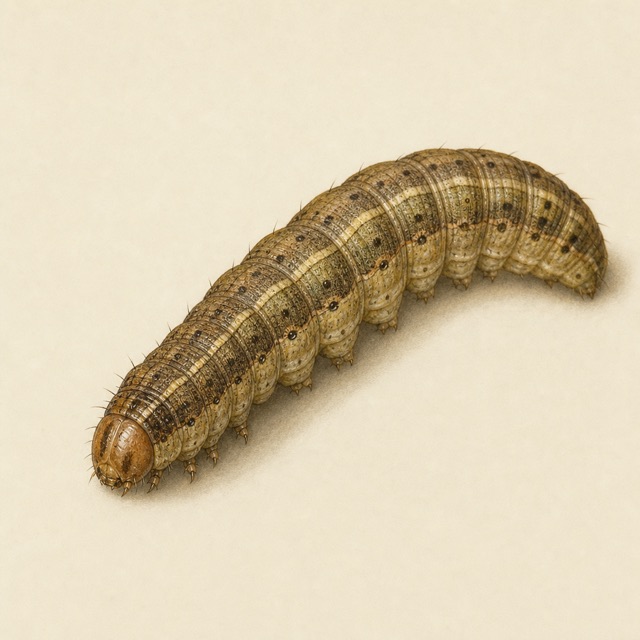
Corn earworms are the most costly crop pest in North America, causing hundreds of millions of dollars in damage annually across corn, tomatoes, peppers, and cotton. In home gardens, these caterpillars bore into corn ears through the silk channel, feeding on developing kernels and leaving behind frass and mold that ruin the harvest. Because larvae feed inside protected plant structures, timing and prevention are far more effective than trying to control them after they have entered the ear.
Corn earworm larvae are medium-sized caterpillars that vary widely in color from pale green to brown, pink, or nearly black, often with alternating light and dark stripes running lengthwise. The head capsule is typically yellowish-brown. Adult moths are stout-bodied with a wingspan of about 1.5 inches, yellowish-tan forewings with a single dark spot, and pale hindwings with a dark border.
Similar Pests
Fall armyworms have a distinctive inverted Y-shaped marking on the head. European corn borers are smaller and pinkish with dark spots. Tobacco budworms look very similar but are more common on tobacco, petunias, and geraniums. In tomatoes, corn earworms are often called tomato fruitworms.
Signs of Infestation
- •Chewed silks at the tip of corn ears
- •Frass and excrement visible at the ear tip when husk is peeled back
- •Entry holes in tomatoes, usually near the stem end
- •Tan-colored moths flying around corn plants at dusk
Key Inspection Areas
- •At the silk end (tip) of corn ears starting when silks first emerge
- •Inside corn ears by carefully peeling back husk tips
- •On tomato fruit near the stem and calyx where larvae enter
- •Around pepper fruits and developing buds
When to Inspect
Monitor moth flights with pheromone traps beginning in mid-summer. Inspect corn silks daily once they begin to emerge and appear fresh. The critical window is from silk emergence through silk browning, as this is when moths lay eggs directly on fresh silks.
Inspection Tools
Pheromone traps for monitoring moth flights, hand lens for spotting eggs on silks, mineral oil and eyedropper for ear tip treatment
Monitor moth flights with pheromone traps
Set up Helicoverpa zea pheromone traps near your corn patch two weeks before expected silking. Check traps every two to three days and record moth counts. When trap catches exceed five moths per night, the risk of earworm infestation is high and active control measures should begin.
Apply mineral oil to corn ear tips
Once corn silks begin to brown and dry (five to six days after silk emergence), apply half a dropper full of mineral oil, vegetable oil, or a Bt-oil mixture to the silk channel at the ear tip. The oil suffocates eggs and young larvae in the silk channel. Time the application carefully as applying too early can interfere with pollination.
Apply Bt spray to fresh silks
Spray Bt var. kurstaki directly onto fresh corn silks every three to five days during the silking period when moth activity is high. Larvae ingest the Bt as they feed on silks before entering the ear. Once larvae are inside the ear, Bt is no longer effective.
Use ear tip clips or rubber bands
After silks have been pollinated and begun to dry, clip the ear tips closed with a clothespin or secure them with a rubber band. This physical barrier prevents moth access to the silk channel. Apply clips five to seven days after silk emergence when pollination is complete.
Release Trichogramma wasps
Purchase and release Trichogramma pretiosum wasps during corn silking to parasitize earworm moth eggs laid on silks. Release cards weekly during the silking period at rates recommended by the supplier. These tiny wasps are highly effective egg parasitoids.
Apply spinosad for heavy moth pressure
When pheromone trap counts indicate heavy moth pressure, spray spinosad on corn silks and surrounding foliage every five to seven days. Apply in the evening to protect pollinators. Spinosad provides effective control of young larvae before they enter the ear.
Harvest promptly and manage crop residues
Harvest corn ears as soon as they mature to minimize damage from late-arriving larvae. After harvest, remove and destroy all corn stalks, ears, and debris. Corn earworm pupae overwinter in the top few inches of soil, so tilling after harvest exposes them to cold and predators.
- 1Plant corn varieties with tight, long husks that provide better physical protection against earworm entry
- 2Time corn planting so silking occurs before or after peak moth flight periods in your region
- 3Use pheromone traps to monitor moth activity and time control measures precisely
- 4Maintain garden sanitation by removing infested ears and crop debris promptly
- 5Encourage natural enemies including Trichogramma wasps, lacewings, and predatory ground beetles
- 6Plant trap crops such as early-blooming sunflowers or sorghum to divert moths from corn
Seasonal Note
Corn earworm moths cannot survive cold winters and recolonize northern regions each summer by migrating from southern overwintering areas. First moth arrivals in northern gardens typically occur in mid to late July. Southern gardeners face year-round pressure.
Is it safe to eat corn that had an earworm?
Yes. Simply cut off the damaged tip of the ear where the earworm was feeding. The remainder of the ear is perfectly safe and nutritious. The worm, its frass, and any moldy kernels should be discarded, but undamaged portions are fine to eat.
Why do corn earworms come in different colors?
Corn earworm larvae are highly polymorphic, meaning their color varies based on genetics, diet, and environmental conditions. Larvae feeding on corn tend to be lighter (green or tan), while those on tomatoes may be darker (brown or greenish-black). All color forms are the same species.
Do corn earworms attack other vegetables?
Yes, corn earworms are generalist feeders that also attack tomatoes (where they are called tomato fruitworms), peppers, beans, lettuce, and many other crops. On tomatoes, they bore into fruit near the stem, creating entry points for rot and disease.
Can I prevent corn earworms by choosing the right corn variety?
Varieties with tight, long husks that extend well past the ear tip offer some natural protection by making it harder for larvae to reach kernels. However, no corn variety is completely immune. Tight-husked varieties combined with other management practices give the best results.
When is the best time to plant corn to avoid earworms?
In northern regions, planting early so that silking occurs before mid-July often avoids the peak moth migration. In southern regions, very early spring plantings may escape the heaviest pressure. Check local extension service resources for region-specific timing recommendations.
Quick Facts
- Size
- 1.5 to 2 inches long when mature
- Color
- Variable: green, brown, pink, or nearly black with light stripes along the body; adult moth is yellowish-tan
- Habitat
- Corn fields, vegetable gardens (especially corn, tomatoes, peppers), and agricultural land
- Active Season
- Summer through early fall, with moth flights peaking in mid to late summer
Danger Level: Medium
This pest can cause health issues or property damage if left untreated.