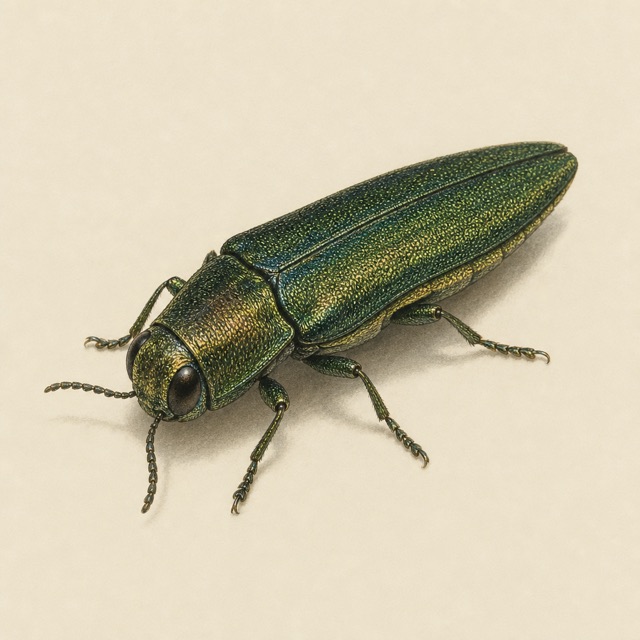
The emerald ash borer (EAB) is the most destructive forest insect ever to invade North America, having killed hundreds of millions of ash trees since its discovery in Michigan in 2002. This metallic green beetle from Asia attacks and kills all species of North American ash trees, and without treatment, infested trees typically die within 3-5 years. Protecting your ash trees requires proactive treatment and ongoing vigilance.
Adult emerald ash borers are strikingly beautiful, narrow, metallic green beetles about half an inch long. When wings are spread, the abdomen reveals a distinctive coppery-red or purple color. Larvae are creamy white, flattened, and segmented with distinctive bell-shaped body segments, growing up to 1.5 inches long beneath the bark.
Similar Pests
Often confused with native metallic wood-boring beetles such as the bronze birch borer or six-spotted tiger beetle. EAB is distinguished by its uniformly bright emerald green color, narrow bullet-shaped body, and exclusive association with ash trees. The six-spotted tiger beetle is found on the ground, not on trees.
Signs of Infestation
- •D-shaped exit holes (about 1/8 inch wide) in ash tree bark -- unique to EAB
- •Serpentine S-shaped larval galleries packed with frass beneath the bark
- •Crown dieback starting from the top third of the tree
- •Increased woodpecker activity with bark flaking from feeding on larvae
Key Inspection Areas
- •All ash trees on your property (look for compound leaves with 5-9 leaflets and diamond-patterned bark)
- •Upper canopy and trunk of ash trees, especially branch unions
- •Bark crevices on the trunk, looking for D-shaped exit holes
- •Beneath loose bark sections for serpentine larval galleries
When to Inspect
Inspect ash trees in late spring through summer when adults are active and D-shaped exit holes are visible. Crown thinning is most apparent in mid-summer.
Inspection Tools
Binoculars for canopy inspection, bark knife for peeling bark samples, purple or green prism EAB traps for monitoring, tree identification guide
Confirm EAB Presence and Identify Ash Trees
First, confirm that your trees are true ash (Fraxinus) species by checking for opposite branching, compound leaves with 5-9 leaflets, and diamond-patterned bark on mature trunks. Look for the telltale D-shaped exit holes, canopy thinning, and epicormic sprouting (shoots growing from the trunk). Contact your local extension office to confirm EAB presence in your county.
Evaluate Tree Health and Treatment Viability
Assess each ash tree's canopy health. Trees with less than 50% canopy loss are generally good candidates for treatment and can recover. Trees with more than 50% canopy dieback are unlikely to survive even with treatment and should be scheduled for removal. Consider the tree's size, location, and landscape value when making treatment decisions.
Choose a Treatment Method
Three main treatment options exist: trunk injection (most effective, done by professionals), soil drench with imidacloprid (DIY-friendly for smaller trees), and trunk/canopy spray with bifenthrin (short-term protection). Trunk injection with emamectin benzoate (TREE-age) provides two years of protection and is the gold standard for EAB treatment.
Apply Systemic Insecticide Treatment
For DIY soil drench: apply imidacloprid-based products (such as Merit or Bayer Advanced Tree & Shrub) around the base of the tree in fall or early spring. For professional trunk injection: hire a certified arborist to inject emamectin benzoate directly into the trunk during active sap flow in spring. Follow all label directions precisely.
Remove and Properly Dispose of Dead Ash Trees
Hire a certified arborist to safely remove dead or heavily damaged ash trees, as they become brittle and hazardous quickly. Chip all removed wood to pieces smaller than 1 inch to destroy larvae, or arrange for disposal at an approved site. Never store or move ash logs, as they can harbor developing EAB for up to two years.
Support Treated Trees
Water treated ash trees deeply during dry periods -- apply 1 inch of water per week over the root zone during summer. Avoid soil compaction over roots and maintain a 3-4 inch mulch ring (not touching the trunk). Do not heavily fertilize stressed trees, as this can attract more beetles. Monitor for canopy recovery in the seasons following treatment.
Establish a Long-Term Management Plan
Commit to retreating protected trees on schedule -- every 2 years for trunk injections, annually for soil drenches. Plant diverse replacement trees (oaks, maples, elms resistant to DED) to maintain canopy cover. Continue monitoring all ash trees for new signs of EAB activity and adjust your management plan with guidance from a certified arborist.
- 1Have a certified arborist assess the health and value of your ash trees to determine if treatment is worthwhile
- 2Apply systemic insecticide treatments to healthy ash trees before EAB arrives in your area
- 3Never transport ash firewood -- buy it where you burn it to prevent spreading EAB
- 4Remove dead or declining ash trees that could fall and cause property damage
- 5Consider diversifying your landscape by planting non-ash replacement trees
- 6Report suspected EAB sightings to your state department of agriculture or USDA APHIS
Seasonal Note
Systemic trunk injections are most effective when applied in mid-spring (April-May) as trees begin active sap flow. Soil drenches can be applied in fall for uptake the following spring.
Can I save my ash tree from emerald ash borer?
Yes, if treatment begins before the tree has lost more than 50% of its canopy. Trunk injections with emamectin benzoate are 95-99% effective at protecting ash trees from EAB when applied on schedule. Treated trees can survive indefinitely as long as treatments continue.
How much does EAB treatment cost?
Professional trunk injection treatments typically cost $100-$300 per tree depending on size, applied every two years. DIY soil drench products cost $20-$50 per tree annually. Compare this to tree removal costs of $500-$3,000+ per tree to determine if treatment is economical.
How do I know if I have ash trees on my property?
Ash trees have opposite branching (branches grow directly across from each other), compound leaves with 5-9 leaflets, and mature bark with a distinctive diamond or interlocking ridge pattern. White ash and green ash are the most common species in landscapes. Your local extension office or a certified arborist can help with identification.
Is emerald ash borer harmful to humans or pets?
No, EAB does not bite, sting, or pose any direct health risk to humans or pets. The danger is entirely to ash trees and the hazards created by dead, falling ash trees. The insecticides used for treatment should be applied according to label directions to minimize any environmental exposure.
How does emerald ash borer spread?
EAB spreads naturally by flight at about 1-2 miles per year from infested areas. However, the primary means of long-distance spread is human transport of infested ash firewood, logs, and nursery stock. This is why firewood quarantines are critical -- always buy firewood locally.
Quick Facts
- Size
- 1/2 inch long, 1/8 inch wide (8-14 mm)
- Color
- Metallic emerald green with a coppery-red or purple abdomen beneath wing covers
- Habitat
- All species of North American ash trees (Fraxinus), both urban landscape and forest settings
- Active Season
- Adults emerge late May through July; larvae feed beneath bark year-round
Danger Level: High
This pest poses significant health or property risks. Act quickly and consider professional help.