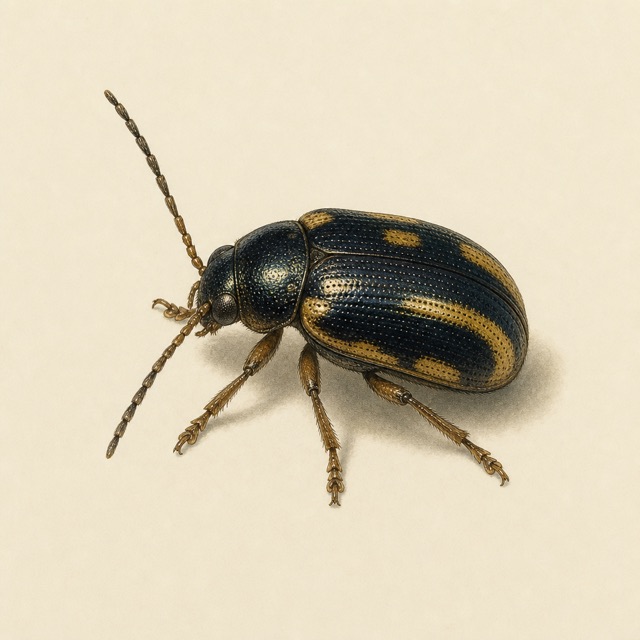
Flea beetles are tiny, jumping insects that riddle plant leaves with hundreds of small holes, giving foliage a distinctive shothole appearance. While established plants can usually tolerate moderate flea beetle feeding, seedlings and transplants are highly vulnerable and can be killed within days. These fast-moving pests attack a wide range of vegetables including brassicas, eggplant, tomatoes, and leafy greens.
Flea beetles are very small, hard-shelled beetles with enlarged hind legs that allow them to jump considerable distances when disturbed, much like a flea. Most species are dark-colored with a metallic sheen, though some have stripes or lighter markings. Their tiny size makes them easy to overlook until damage becomes apparent.
Similar Pests
Flea beetle damage (small round holes) can be confused with slug damage, but slug holes are irregular and accompanied by slime trails. The beetles themselves might be mistaken for other small beetles, but their characteristic jumping behavior is distinctive.
Signs of Infestation
- •Numerous small round holes (shotholes) in leaves
- •Leaves with a lace-like or skeletonized appearance in severe cases
- •Tiny jumping beetles visible on leaf surfaces when plants are disturbed
- •Seedlings wilting or dying from heavy feeding pressure
Key Inspection Areas
- •On the upper and lower surfaces of leaves, especially brassicas and eggplant
- •Around newly transplanted seedlings and direct-seeded rows
- •In garden bed soil where larvae feed on roots
- •Along weedy borders and in leaf litter where adults overwinter
When to Inspect
Inspect on warm, sunny mornings when flea beetles are most active. They are less active in cool or overcast conditions. Spring inspections are most critical when overwintered adults emerge and seedlings are most vulnerable.
Inspection Tools
White sticky traps placed at soil level, hand lens for identification, row cover material for protection
Identify the flea beetle species and damage level
Examine damaged plants closely with a hand lens to confirm flea beetle presence. Tap plants over a white sheet of paper to dislodge beetles for counting. Determine if damage is cosmetic on mature plants or threatening to seedling survival.
Protect seedlings with row covers
Install lightweight floating row covers over vulnerable seedling beds, securing edges tightly with soil or staples. This physical barrier is the single most effective flea beetle control for young plants. Keep covers in place until plants are well established.
Apply kaolin clay spray
Mix Surround WP kaolin clay according to label directions and spray all plant surfaces thoroughly. The white clay coating creates a physical barrier that confuses and deters flea beetles without harming plants. Reapply after rain and as new growth appears.
Use neem oil as a repellent and feeding deterrent
Spray plants with neem oil solution (2 tablespoons per gallon of water with a drop of dish soap as emulsifier) in the evening. Neem acts as a feeding deterrent and disrupts beetle reproduction. Apply every seven to ten days during active beetle season.
Deploy yellow sticky traps
Place yellow sticky traps at canopy height throughout the garden to capture adult flea beetles. While traps alone will not control an infestation, they are valuable for monitoring population levels and timing additional control measures.
Apply spinosad for heavy infestations
For severe infestations threatening plant survival, apply OMRI-listed spinosad spray according to label rates. Apply in the evening to minimize impact on pollinators. Spinosad provides effective knockdown of adult flea beetles for up to one week.
Cultivate soil in fall and spring
Lightly till or cultivate garden beds in late fall to expose overwintering flea beetle adults to cold temperatures and predators. Repeat shallow cultivation in early spring before planting. Remove all crop debris and cruciferous weeds that serve as early-season food sources.
- 1Cover seedling beds with floating row covers immediately after planting to exclude beetles
- 2Delay planting susceptible crops until late spring when beetle pressure decreases
- 3Start seedlings indoors and transplant larger, more robust plants that can tolerate some feeding
- 4Keep garden beds weed-free, especially of cruciferous weeds that harbor flea beetles
- 5Apply a thick layer of straw mulch around plants to disrupt beetle movement and egg-laying
- 6Rotate crops annually to prevent beetle populations from building up in one location
Seasonal Note
Flea beetles overwinter as adults in soil and leaf litter, emerging in early spring when temperatures reach 50°F. The heaviest damage occurs in the first four to six weeks of spring. Fall tillage can reduce overwintering populations.
Will flea beetles kill my plants?
Flea beetles can kill young seedlings and transplants through heavy feeding. Established plants usually survive moderate flea beetle damage, though severe infestations can reduce yields and weaken plants enough to invite secondary problems.
Are flea beetles the same as fleas?
No, flea beetles are not related to fleas. They are plant-feeding beetles that earned their name because of their powerful jumping ability, which resembles flea behavior. They do not bite humans or animals.
What vegetables do flea beetles prefer?
Flea beetles most commonly target brassicas (cabbage, broccoli, kale, arugula), eggplant, potatoes, tomatoes, peppers, and radishes. Different flea beetle species have different host preferences, but most are attracted to plants in the mustard and nightshade families.
Do flea beetles spread plant diseases?
Some flea beetle species can transmit plant diseases, most notably Stewart's wilt in corn and various viral diseases. The feeding wounds they create also provide entry points for bacterial and fungal pathogens.
How do I tell flea beetle damage from other pest damage?
Flea beetle damage produces distinctive small, round shotholes that give leaves a peppered appearance. This pattern is unique among garden pests. If you see these holes and tiny beetles that jump when disturbed, you can be confident the damage is from flea beetles.
Quick Facts
- Size
- 0.06 to 0.12 inches (1.5 to 3 mm)
- Color
- Black, bronze, bluish, or striped depending on species; often with a metallic sheen
- Habitat
- Vegetable gardens, crop fields, weedy borders, and overwintering in leaf litter and soil
- Active Season
- Early spring through summer, most damaging in spring when seedlings are young
Danger Level: Low
This pest is primarily a nuisance but can be eliminated with DIY methods.