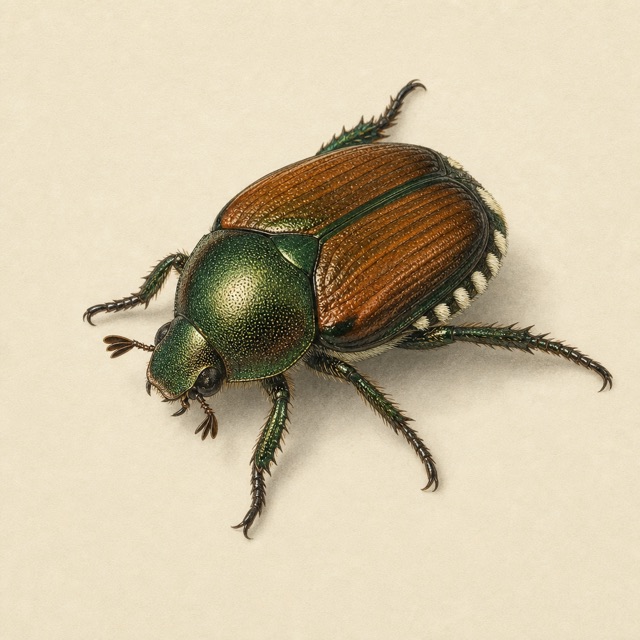
Japanese beetles are beautiful but destructive invaders that can skeletonize your prized roses and garden plants in days. These metallic green beetles with copper wings arrive in swarms each summer, feeding on over 300 plant species while their grubs destroy lawn roots below ground. Understanding their two-stage lifecycle is the key to effective control.
Japanese Beetles: Complete Guide are identifiable by their Metallic green body with copper-brown wing covers coloring and 3/8 - 1/2 inch size. Scientific name: Popillia japonica. They have distinct physical features that help differentiate them from similar pests.
Signs of Infestation
- •Physical sightings of the pest in or around the affected area
- •Damage patterns characteristic of this pest's feeding or nesting behavior
- •Droppings, shed skins, or other biological evidence of infestation
Key Inspection Areas
- •Areas where Gardens, lawns, ornamental plants, fruit trees, and agricultural areas throughout eastern and midwestern United States is commonly found
- •Entry points and harborage sites specific to this pest
- •Food and water sources that attract this pest
When to Inspect
Inspect during peak activity times for this pest. Check regularly during their active season (Adults active June through August; grubs present in soil spring and fall).
Inspection Tools
Flashlight for inspecting dark areas, appropriate traps for monitoring
Identify the Infestation Stage
Determine whether you're dealing with adult beetles (above ground) or grubs (in soil). Adult beetles leave skeletonized leaves with only veins remaining, while grubs cause irregular brown patches in lawns that peel back easily. Check the underside of damaged leaves in early morning when beetles are sluggish and easier to spot. Look for white C-shaped grubs when digging 2-3 inches into affected lawn areas.
Remove Adult Beetles by Hand
For small infestations, hand-pick beetles in early morning when they're less active and drop them into soapy water. Japanese beetles release aggregation pheromones when feeding, attracting more beetles, so removing them early prevents larger swarms. Focus on heavily infested plants first, especially roses, grapes, and linden trees. This method works best when done daily during peak season and is completely pesticide-free.
Apply Targeted Insecticides to Foliage
Spray affected plants with products containing carbaryl (Sevin), pyrethrins, or neem oil for organic options. Apply Bonide Eight or Spectracide Triazicide in late afternoon to protect pollinators, targeting the undersides of leaves where beetles congregate. Reapply every 7-14 days during active beetle season. Avoid spraying open blooms, and always follow label instructions for edible plants.
Treat Your Lawn for Grubs
Apply grub control products like Bayer Season-Long Grub Control (imidacloprid) or Scotts GrubEx in late spring or early summer before eggs hatch. For active grub infestations in fall, use faster-acting products like BioAdvanced 24 Hour Grub Killer (trichlorfon). Water the lawn thoroughly after application to move the insecticide into the root zone where grubs feed. Treating grubs reduces next year's adult beetle population significantly.
Use Beneficial Nematodes for Organic Grub Control
Apply Heterorhabditis bacteriophora or Steinernema glaseri nematodes to moist soil in late summer or early fall when grubs are small and vulnerable. Mix nematodes with water according to package directions and apply with a hose-end sprayer or watering can. Keep soil moist for 2 weeks after application to ensure nematode survival. This biological control is safe for pets, children, and beneficial insects.
Install Physical Barriers and Row Covers
Protect high-value plants with fine mesh netting or floating row covers during peak beetle season (late June through July). Drape lightweight fabric over plants and secure edges to prevent beetle access while allowing light and water through. This works especially well for vegetable gardens and prized ornamentals. Remove covers periodically to allow pollination of flowering plants.
Avoid Japanese Beetle Traps
Despite their popularity, pheromone traps often attract more beetles than they catch, making infestations worse. Studies show traps can draw beetles from up to a quarter-mile away, creating a buffet of your plants. If you must use traps, place them at least 30 feet away from gardens and ornamentals, downwind of areas you want to protect. Empty traps frequently to prevent them from becoming ineffective.
Implement Long-Term Prevention Strategies
Maintain healthy, thick turf through proper watering and fertilization to make your lawn less attractive to egg-laying females. Consider replacing highly attractive plants like roses, grapes, and lindens with resistant varieties such as dogwood, forsythia, or holly. Apply milky spore (Paenibacillus popilliae) to lawns for long-term grub suppression—it takes 2-3 years to establish but can last decades once established.
- 1Eliminate food sources and properly store food items
- 2Reduce moisture and fix any water leaks
- 3Seal entry points and potential access routes
- 4Maintain cleanliness and reduce clutter that provides harborage
- 5Monitor regularly and address problems early before populations grow
Do Japanese beetle traps actually work?
Japanese beetle traps typically make problems worse rather than better. While they do catch beetles, the pheromone lures attract far more beetles to your yard than the trap captures. Research shows traps can draw beetles from a quarter-mile away, creating a congregation that damages nearby plants. If you're dealing with a serious infestation, hand-picking and targeted spraying are much more effective control methods.
What plants do Japanese beetles hate?
Japanese beetles avoid certain plants including boxwood, forsythia, dogwood, red maple, magnolia, holly, and most evergreens. They also steer clear of herbs like catnip, tansy, garlic, and chives. Consider using these resistant plants as a buffer around more vulnerable specimens like roses, grapes, and fruit trees. However, no plant is completely beetle-proof when populations are extremely high.
When is the best time to treat for Japanese beetle grubs?
The optimal time for preventive grub treatment is late June through mid-July when adult beetles are laying eggs but before they hatch. For curative treatment of existing grubs, apply products in late summer (August-September) when grubs are actively feeding near the soil surface. Spring treatments are less effective because larger grubs are about to pupate and become adults, making them more resistant to insecticides.
How long does milky spore take to work against Japanese beetles?
Milky spore disease takes 2-3 years to become fully established in your lawn, so it's a long-term solution rather than a quick fix. Once established, it can persist in soil for 15-20 years or longer, providing ongoing grub suppression. Apply milky spore powder to your lawn in spring or fall when soil temperatures are above 65°F. It works best in areas with consistent Japanese beetle populations to help the bacteria spread throughout the soil.
Will Japanese beetles eventually go away on their own?
Adult Japanese beetles typically disappear naturally by late August as their lifecycle completes, but they'll return next summer if grubs survive in the soil over winter. Without intervention, populations often increase year after year as beetles establish themselves in an area. Taking action against both adults and grubs breaks this cycle and reduces future infestations significantly.
Quick Facts
- Size
- 3/8 - 1/2 inch
- Color
- Metallic green body with copper-brown wing covers
- Habitat
- Gardens, lawns, ornamental plants, fruit trees, and agricultural areas throughout eastern and midwestern United States
- Active Season
- Adults active June through August; grubs present in soil spring and fall
Danger Level: High
This pest poses significant health or property risks. Act quickly and consider professional help.