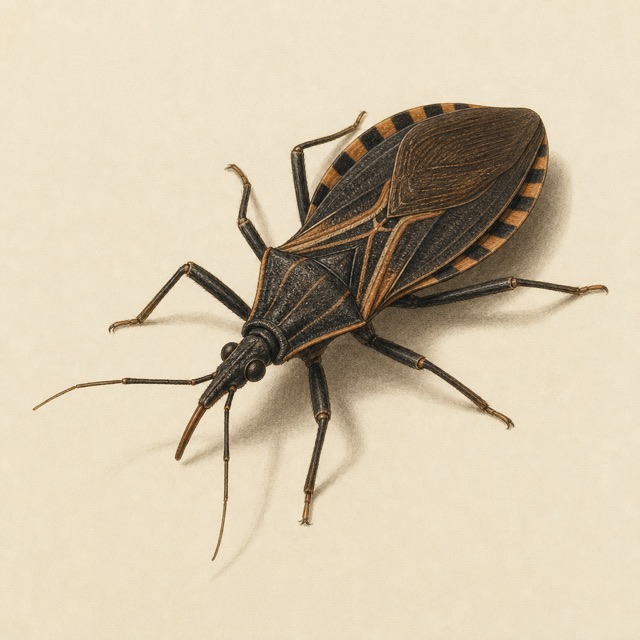
Kissing bugs are blood-feeding insects that bite sleeping humans around the mouth and eyes, potentially transmitting Chagas disease — a serious parasitic infection that can cause lifelong heart and digestive problems. Found primarily in the southern US, these nocturnal pests are a genuine health threat. Here's how to identify them, protect your home, and respond if you find one.
Kissing bugs are oval-shaped, flattened insects 1/2 to 1.25 inches long with a distinctive cone-shaped head and thin, straight beak. They're dark brown to black with orange, red, or yellow striped markings along the edges of the abdomen. Their body is wider than their head and they have thin legs and long antennae.
Similar Pests
Often confused with wheel bugs, leaf-footed bugs, and western conifer seed bugs — which are harmless. Key differences: kissing bugs have a cone-shaped head, straight beak tucked under the body, and lack the leaf-shaped leg extensions of leaf-footed bugs or the wheel-shaped crest of wheel bugs.
Signs of Infestation
- •Painless bite marks found upon waking, often near the mouth, eyes, or on the face
- •Small blood spots or dark fecal streaks on pillows, sheets, or near beds
- •Adult bugs found near pet sleeping areas, in bedrooms, or around porch lights at night
- •Allergic reactions to bites including swelling, redness, and in rare cases anaphylaxis
Key Inspection Areas
- •Cracks and gaps in walls, especially in older homes and adobe or stone construction
- •Around pet sleeping areas — dog beds, kennels, and outdoor pet houses
- •Woodpiles, rock walls, brush piles, and rodent nests near the home
- •Under porches, in crawl spaces, and around exterior light fixtures where bugs are attracted
When to Inspect
Inspect at night when kissing bugs are active feeders. They're most commonly found from May through October. Check around outdoor lights after dark — adults are attracted to light. Inspect indoor areas around beds and pet resting areas.
Inspection Tools
Flashlight for nighttime inspection, collection container (don't crush the bug — save it for identification), white sheets on beds to spot fecal streaks, gloves for handling
Confirm identification — do not crush the bug
If you find a suspected kissing bug, capture it in a container without crushing it. Crushing can release the parasite (Trypanosoma cruzi) that causes Chagas disease. Compare it to confirmed photos — look for the cone-shaped head and striped abdomen edges.
Report and submit the specimen
Contact your local health department or university extension service. Many states in the southern US have kissing bug identification and testing programs. The CDC recommends submitting specimens for Chagas disease parasite testing.
Seal all entry points into the home
Caulk cracks around doors, windows, walls, and the foundation. Install weatherstripping and door sweeps. Repair or replace damaged screens. Pay special attention to gaps around utility entry points, weep holes, and attic vents.
Eliminate outdoor harborage near the home
Remove woodpiles, rock piles, and brush within 20 feet of the house. Clear vegetation from foundation walls. Seal or remove rodent and wildlife nesting areas — kissing bugs feed on rodents, opossums, and other animals before moving to human hosts.
Apply residual insecticide around the home perimeter
Apply a pyrethroid insecticide (bifenthrin, cyfluthrin, or lambda-cyhalothrin) around the foundation, doorframes, window frames, and eaves. Dust wall voids and attic spaces with Delta Dust or boric acid. Reapply every 3 months during active season.
Protect sleeping areas
Inspect bedrooms thoroughly. Use bed nets (fine mesh) in areas with known kissing bug activity. Keep beds away from walls. Remove clutter under and around beds that could harbor bugs. Check pet sleeping areas and treat with pet-safe insecticide.
Consult a doctor if bitten
If you suspect kissing bug bites, see a doctor for Chagas disease testing. Early detection is critical — acute Chagas disease is treatable with antiparasitic medication, but chronic infection can cause serious heart and digestive complications years later.
- 1Seal all cracks and gaps in walls, around doors and windows, and in the foundation with caulk or weatherstripping
- 2Install tight-fitting screens on all windows and doors; repair any holes in existing screens
- 3Move woodpiles, brush piles, and rock walls at least 20 feet from the home
- 4Eliminate rodent nests and wildlife harborage near the home — rodents are primary hosts
- 5Turn off or relocate outdoor lights away from doors and windows to reduce attraction
- 6Bring pet beds indoors at night and keep dog houses away from the main structure
Seasonal Note
Kissing bugs are most active from May through September in the southern US. Seal entry points before warm weather begins. They're attracted to lights and often enter homes in summer through gaps around doors and windows.
What is Chagas disease?
Chagas disease is caused by the parasite Trypanosoma cruzi, transmitted through kissing bug feces — not the bite itself. The bug defecates near the bite wound, and the parasite enters when the person scratches the area. It can cause heart failure and digestive complications years after infection.
Where are kissing bugs found in the US?
Kissing bugs are found across the southern US, from California to Florida, and as far north as Pennsylvania. They're most common in Texas, Arizona, New Mexico, and other southwestern states. At least 11 Triatoma species are found in the US.
Do all kissing bugs carry Chagas disease?
No. Not all kissing bugs are infected with T. cruzi. Infection rates vary by species and region — some studies find 50% or more of certain species carry the parasite in parts of Texas and Arizona. However, any kissing bug should be treated as a potential carrier.
How do I tell a kissing bug from a similar-looking bug?
Look for three key features: a cone-shaped head much narrower than the body, a thin straight beak tucked under the body (not held outward), and orange or red stripes along the edges of a flat abdomen. Wheel bugs have a gear-shaped crest; leaf-footed bugs have flattened leg extensions.
Can my dog get Chagas disease?
Yes. Dogs are frequently infected with Chagas disease in endemic areas and can develop fatal heart disease. Dogs that eat kissing bugs or are bitten can become infected. Consult your veterinarian about testing if you live in an area with kissing bugs.
Quick Facts
- Size
- 1/2 - 1.25 inches
- Color
- Dark brown to black with orange or red striped markings along the body edges
- Habitat
- Woodpiles, animal nests, rock crevices, and cracks in homes near animal hosts
- Active Season
- Spring through fall, most active in warm months
Danger Level: High
This pest poses significant health or property risks. Act quickly and consider professional help.