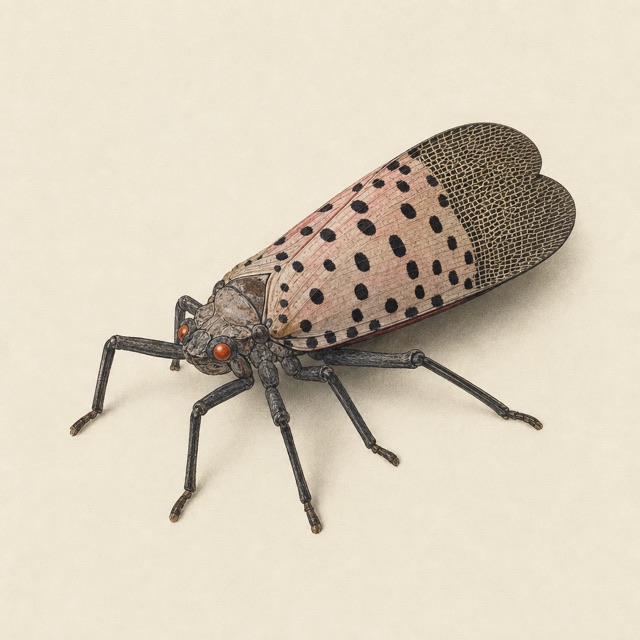
The spotted lanternfly is an invasive planthopper from Asia that has rapidly spread across the eastern United States since its 2014 detection in Pennsylvania, threatening agriculture, forests, and quality of life. This pest feeds on over 70 plant species -- with a strong preference for tree of heaven, grapevines, maples, and fruit trees -- excreting copious sticky honeydew that coats surfaces and promotes sooty mold growth. Reporting sightings and actively managing this pest is critical to slowing its spread.
Adult spotted lanternflies are strikingly distinctive: at rest, their folded forewings are gray-pink with black spots, but when they fly or are startled, they reveal vivid red hindwings with black spots and a bold white band. They are planthoppers (not flies or moths) that jump powerfully but are weak fliers. Nymphs progress through four stages, starting black with white spots and developing red patches before the final molt to adult.
Similar Pests
Early nymph stages (black with white spots) may be confused with ticks by people unfamiliar with the pest. Adults at rest may superficially resemble certain moths. The red hindwings revealed during jumping are unmistakable. No other insect in North America combines the gray spotted forewings with red hindwings.
Signs of Infestation
- •Gray, mud-like egg masses on trees, stones, vehicles, and outdoor furniture (fall through spring)
- •Black-and-white spotted nymphs clustered on tree trunks and plant stems (spring/summer)
- •Sticky honeydew accumulation on leaves, sidewalks, cars, and patio furniture
- •Black sooty mold growing on honeydew-coated surfaces beneath infested trees
Key Inspection Areas
- •Tree of heaven (Ailanthus altissima) -- their preferred host tree
- •Grapevines, hops, maples, walnuts, birch, and willow trees
- •Any smooth surface for egg masses: tree bark, fence posts, stone walls, vehicles, outdoor furniture
- •Railroad infrastructure, shipping containers, and vehicles that may transport egg masses
When to Inspect
Look for egg masses October through April on any outdoor surface. Watch for nymphs from May through July on host plants. Adults are most visible August through November feeding on tree trunks and swarming on tree of heaven.
Inspection Tools
Scraping tool (plastic card or putty knife) for removing egg masses, bucket of rubbing alcohol or hand sanitizer for destroying eggs, sticky bands for trapping nymphs, spray bottle with contact insecticide
Search for and Destroy Egg Masses
From October through April, systematically inspect all outdoor surfaces for spotted lanternfly egg masses. They appear as gray-brown, mud-like smears about 1 inch long on tree trunks, fence posts, stone walls, vehicles, patio furniture, and any smooth surface. Scrape egg masses into a container of rubbing alcohol or hand sanitizer to kill the eggs. Scraping them onto the ground is not sufficient -- the eggs can still hatch.
Install Trapping Bands on Trees
Wrap sticky bands or circle traps around the trunks of known host trees (tree of heaven, maples, walnuts) at chest height to capture nymphs and adults as they crawl up to feed. Use commercially available circle traps (mesh funnel design) rather than open sticky bands, which can trap birds and beneficial insects. Check and replace traps every 2 weeks during active season.
Remove or Treat Tree of Heaven
Tree of heaven is the spotted lanternfly's preferred host and a magnet for populations. Remove female tree of heaven trees (those that produce seeds) from your property. Alternatively, treat a few male trees with systemic insecticide (dinotefuran or imidacloprid) and leave them standing as trap trees that kill feeding lanternflies while attracting them away from valued plants.
Apply Contact Insecticides to Congregating Sites
When nymphs or adults are found congregating on trees, fences, or structures, spray directly with contact insecticides containing bifenthrin, carbaryl, or pyrethrin. For organic options, neem oil and insecticidal soap provide knockdown on contact but lack residual activity. Target trunk-feeding aggregations in the evening when beneficial pollinators are less active.
Use Systemic Insecticide for High-Value Trees
Protect high-value landscape and fruit trees with systemic insecticides applied as soil drenches or trunk injections. Dinotefuran (Safari) provides the fastest uptake and is effective within days. Imidacloprid works but takes several weeks for full uptake. Do not apply systemics to trees that are in bloom to protect pollinators. Follow all label directions and state regulations.
Manage Honeydew and Sooty Mold
Clean honeydew residue from outdoor furniture, vehicles, patios, and decks with warm soapy water or a pressure washer. Sooty mold on plants can be washed off with a strong water spray and will not permanently harm plant foliage -- it disappears once the honeydew source is eliminated. Power wash hardscaping that has become slippery from honeydew accumulation.
Report Sightings and Coordinate Community Response
Report spotted lanternfly sightings outside known infested areas to your state department of agriculture -- early detection is crucial for containment. Coordinate with neighbors for area-wide egg mass scraping and tree of heaven removal, as individual property management is less effective in isolation. Comply with quarantine regulations if your county is in a quarantine zone.
- 1Learn to identify and scrape egg masses from all outdoor surfaces between October and May
- 2Remove tree of heaven (Ailanthus altissima) from your property, or treat with systemic herbicide to use as trap trees
- 3Inspect vehicles, trailers, and outdoor equipment before traveling from quarantine zones
- 4Report new sightings outside known infested areas to your state department of agriculture
- 5Install circle traps or sticky bands on known host trees to capture nymphs and adults
- 6Check firewood, stone, and landscaping materials for hitchhiking egg masses before transport
Seasonal Note
Egg mass scraping from October through April is the most impactful prevention activity. Each egg mass contains 30-50 eggs, and they are laid on virtually any outdoor surface. Check your property thoroughly before spring hatch begins.
Should I kill spotted lanternflies when I see them?
Yes. In infested areas, killing spotted lanternflies on sight is encouraged by state agriculture departments. Stomp adults and nymphs, scrape and destroy egg masses, and report sightings in new areas. Every individual killed helps reduce the population and slow the spread.
Are spotted lanternflies harmful to humans or pets?
Spotted lanternflies do not bite, sting, or carry diseases that affect humans or pets. They are not toxic if accidentally ingested by pets. The primary impacts are to plants, agriculture (especially grapes and fruit trees), and quality of life due to honeydew and sooty mold on outdoor surfaces.
What plants do spotted lanternflies damage most?
Grapevines and tree of heaven suffer the most severe damage. Spotted lanternflies also significantly affect maples, walnuts, birch, willow, fruit trees (apple, peach, plum), and hops. They feed on over 70 plant species but cause the greatest economic damage to vineyards and orchards.
How do spotted lanternflies spread?
While adults can fly short distances, the primary means of long-distance spread is hitchhiking. Egg masses are laid on vehicles, trailers, railroad cars, stone, firewood, and outdoor equipment. When these items are transported, the egg masses travel along and hatch in new areas. This is why quarantine inspections are critical.
Will spotted lanternflies ever be eradicated?
Complete eradication is considered unlikely at this point due to the pest's wide establishment across the eastern US. However, management efforts focus on slowing the spread, protecting agriculture, and developing biological control agents. Researchers are studying natural enemies from the lanternfly's native range in Asia for potential biocontrol release.
Quick Facts
- Size
- Adults about 1 inch long with wings spread to 2 inches
- Color
- Forewings gray with black spots; hindwings red with black spots and white band; abdomen yellow with black bands
- Habitat
- Tree of heaven, grapevines, maples, walnuts, willows, fruit trees, and many hardwoods
- Active Season
- Nymphs appear April through July; adults active July through December; egg masses persist through winter
Danger Level: High
This pest poses significant health or property risks. Act quickly and consider professional help.