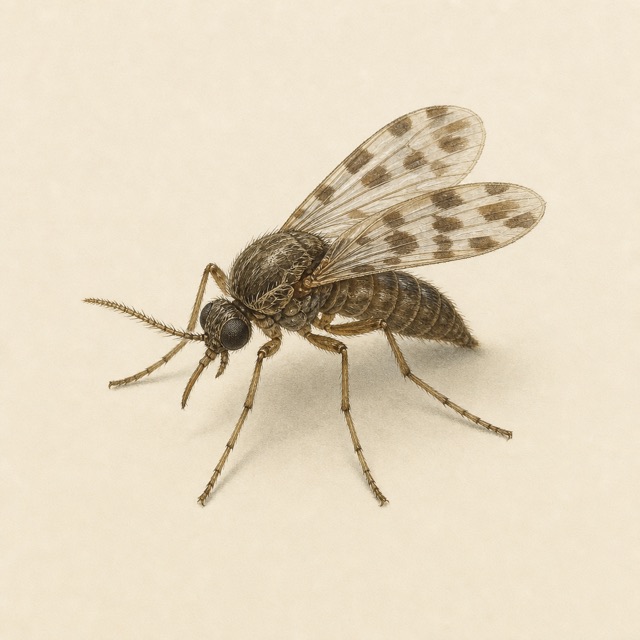
No-see-ums are tiny biting midges so small they can pass through standard window screens, earning them their name. Despite being nearly invisible, their bites pack a disproportionate punch — causing intense itching, welts, and sometimes allergic reactions that last for days. Here's how to protect yourself and reduce populations around your property.
No-see-ums (biting midges) are extremely small flies, typically only 1-3mm long. They have short legs, two wings with distinctive patterns visible under magnification, and piercing-sucking mouthparts. They're so small they appear as tiny moving specks and are often felt before they're seen.
Similar Pests
Often confused with sand flies, gnats, or black flies. Sand flies are slightly larger and hop rather than fly. Gnats (fungus gnats, fruit flies) don't bite. Black flies are larger, stockier, and humpbacked. Mosquitoes are significantly larger with longer legs and a visible proboscis.
Signs of Infestation
- •Clusters of small, intensely itchy red welts appearing after time outdoors at dawn or dusk
- •Tiny flies passing through standard window screens and biting indoors
- •Bites concentrated on exposed skin — ankles, arms, neck, and face
- •Swarms of nearly invisible insects hovering near ground level in humid areas
Key Inspection Areas
- •Near standing water, salt marshes, mangroves, and wet sandy soil
- •Around irrigation systems, pond edges, and low-lying moist areas
- •Shaded humid areas near vegetation, especially during calm conditions
- •Around screened porches and windows where tiny flies may be passing through mesh
When to Inspect
No-see-ums are most active at dawn and dusk in calm, humid conditions. Some species also bite during overcast midday hours. They're inactive in wind above 5-7 mph. Peak season varies by region — coastal areas see activity from March through October.
Inspection Tools
Magnifying glass to confirm identification, fine-mesh screening (smaller than 16x16 mesh) for testing screen penetration
Confirm you're dealing with no-see-ums
Look for clusters of tiny, intensely itchy bites that appeared after dawn or dusk outdoor activity. If bites occur indoors near windows, check if tiny flies are passing through standard screens. No-see-ums are smaller than the mesh of most window screens.
Install no-see-um mesh screening
Replace standard screen mesh (typically 18x16) with fine no-see-um mesh (20x20 or smaller). This is the most effective long-term solution for preventing indoor bites. It slightly reduces airflow, so consider combining with fans.
Set up CO2 and UV traps
Install CO2-emitting insect traps (like Mega-Catch or SkeeterVac) in your yard, positioned 20-40 feet from seating areas. These attract and capture biting midges using carbon dioxide and UV light. Run continuously during peak season.
Create wind barriers around outdoor spaces
Install oscillating or box fans around patios, porches, and outdoor dining areas. No-see-ums are extremely weak fliers and cannot navigate even moderate wind. A sustained breeze of 5-7 mph is enough to keep them away.
Treat outdoor areas with residual insecticide
Apply bifenthrin or permethrin spray to vegetation, shrubs, and shaded rest areas around your yard. Focus on areas 20-30 feet around outdoor living spaces. Reapply every 3-4 weeks during peak season.
Use personal repellents strategically
Apply repellent with 25-30% DEET, 20% picaridin, or oil of lemon eucalyptus to exposed skin. Treat clothing with permethrin. Reapply as directed. Personal repellent is your primary defense when away from home.
Reduce breeding habitat on your property
Eliminate standing water, improve drainage in low areas, and reduce overwatering from irrigation. Clean clogged gutters and birdbaths weekly. While you can't control marshes and waterways, reducing breeding sites on your property helps lower local populations.
- 1Replace standard window screens with fine-mesh no-see-um screening (20x20 or finer mesh)
- 2Install outdoor fans on porches and patios — no-see-ums cannot fly in moderate wind
- 3Eliminate standing water and improve drainage around your property
- 4Apply DEET or picaridin-based repellent to exposed skin before going outdoors at dawn/dusk
- 5Wear light-colored long sleeves and pants during peak activity periods
- 6Avoid being outdoors in calm, humid conditions at dawn and dusk near water
Seasonal Note
No-see-um season peaks from May through September in most regions. Coastal and tropical areas may experience year-round activity. Early morning and evening outdoor plans should account for no-see-um activity during warm months.
Why do no-see-um bites itch so much?
No-see-ums inject saliva containing anticoagulants and proteins that trigger an allergic-type immune response. The intense itching and swelling is your body's reaction to these foreign proteins. Some people develop stronger reactions with repeated exposure.
Can no-see-ums get through window screens?
Yes. Standard window screen mesh (18x16 or 18x14) has openings large enough for no-see-ums to pass through. You need fine no-see-um mesh (20x20 or smaller) to keep them out. This is one of their most frustrating characteristics.
What's the best repellent for no-see-ums?
DEET (25-30% concentration) and picaridin (20%) are the most effective. Oil of lemon eucalyptus also works but requires more frequent reapplication. Natural repellents are generally less effective against no-see-ums than against mosquitoes.
Do no-see-ums carry diseases?
In the US, no-see-ums are primarily a nuisance pest. However, in tropical regions, certain Culicoides species transmit viruses to livestock (bluetongue, African horse sickness) and can rarely transmit Oropouche virus to humans in Central and South America.
Why are no-see-ums worse at certain times of day?
Most no-see-um species are crepuscular — active at dawn and dusk when humidity is high and wind is calm. Some species also bite during overcast, humid midday conditions. They're essentially inactive in direct sun, low humidity, or wind above 5-7 mph.
Quick Facts
- Size
- 1/32 - 1/16 inch
- Color
- Gray to dark brown, nearly invisible to the naked eye
- Habitat
- Salt marshes, mangrove swamps, moist soil, sandy coastal areas, and near standing water
- Active Season
- Spring through fall, peak in warm humid months
Danger Level: Medium
This pest can cause health issues or property damage if left untreated.