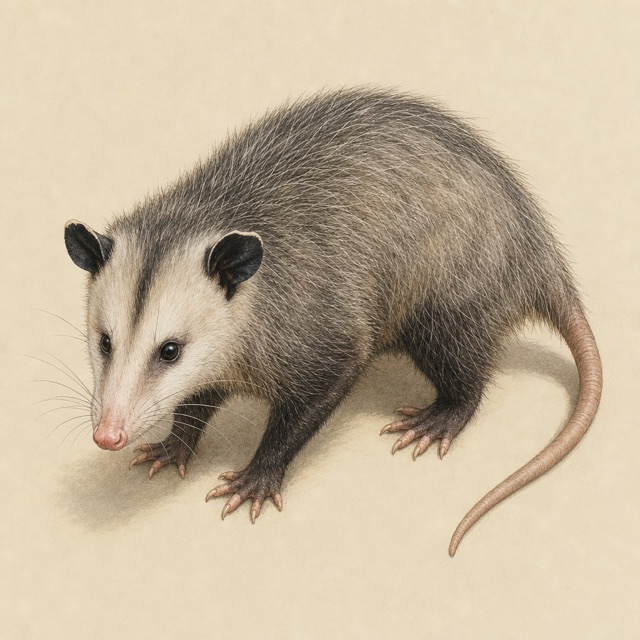
Opossums are North America's only marsupial, and while they provide some ecological benefits like eating ticks and carrion, they become a nuisance when they den under porches, raid garbage cans, and leave droppings around your property. Understanding their behavior is key to humane and effective removal.
Opossums have a distinctive pointed white face, dark round eyes, and rounded hairless ears. Their coarse fur is grayish-white, and they have a long, scaly, prehensile tail used for balance. They are roughly the size of a house cat but with shorter legs and a more elongated snout.
Similar Pests
Sometimes mistaken for large rats due to their hairless tail, but opossums are much larger. At night they may be confused with raccoons, but opossums lack the black face mask and have a distinctly pointed snout rather than a rounded face.
Signs of Infestation
- •Overturned trash cans and scattered garbage with torn bags
- •Disappearing pet food left outdoors overnight
- •Large, irregularly shaped droppings near den sites that may resemble dog feces
- •Scratching or hissing sounds under porches, decks, or in crawl spaces at night
Key Inspection Areas
- •Under decks, porches, and raised sheds
- •Crawl spaces and garage corners
- •Dense brush piles and overgrown vegetation
- •Near outdoor pet feeding stations and trash cans
When to Inspect
Inspect at dusk or after dark when opossums emerge to forage. Use a flashlight to look for eye-shine under structures. Daytime inspections can reveal den sites by looking for hair tufts, droppings, and worn trails.
Inspection Tools
Powerful flashlight for nighttime inspection, a mirror on an extendable handle for checking under low structures, and a wildlife camera for confirming activity patterns
Confirm opossum activity
Set up a wildlife camera near suspected den sites or along travel routes. Look for their distinctive tracks showing a splayed five-toed hind foot with an opposable thumb. Droppings and scattered trash are also reliable indicators of opossum presence.
Remove all food attractants
Bring pet food indoors, secure garbage in sealed containers, clean up fallen fruit, and remove bird feeders or switch to designs that do not scatter seed on the ground. Eliminating food sources is the single most effective step in encouraging opossums to move on.
Use deterrents to make the area uncomfortable
Place motion-activated sprinklers and lights near den sites and along known travel paths. Sprinkle commercial animal repellent or scatter ammonia-soaked rags near entrances. Opossums prefer dark, quiet areas and will often leave voluntarily when disturbed.
Install a one-way exclusion door
If an opossum is denning under a structure, mount a one-way exclusion funnel over the entry point after confirming no young are present inside. Leave it in place for at least 5 to 7 days and check with a camera or by placing loose newspaper in the opening to verify departure.
Seal all entry points
Once the opossum has vacated, permanently close the opening with heavy-gauge hardware cloth or welded wire mesh. Bury the barrier at least 6 inches below ground in an L-shape extending 12 inches outward to prevent digging underneath.
Live trap as a last resort
If exclusion is not feasible, set a large live trap baited with canned cat food, fruit, or marshmallows near active trails. Check traps every 4 to 6 hours. Contact your local wildlife agency for relocation regulations, as rules vary significantly by state.
Maintain and monitor the property
Continue keeping food sources secured and monitor previously sealed areas monthly for signs of tampering. Opossums are nomadic and may move on within a few weeks on their own once attractants are removed, but ongoing maintenance prevents new individuals from taking their place.
- 1Secure trash cans with tight-fitting lids and do not place bins out until the morning of collection
- 2Never leave pet food or water bowls outdoors overnight
- 3Close off crawl spaces, deck undersides, and shed bases with galvanized hardware cloth buried 6 inches deep
- 4Remove fallen fruit, berries, and bird seed from the ground daily
- 5Trim dense shrubs and brush piles away from the home foundation
- 6Install motion-activated lights near known entry points to deter these nocturnal animals
Seasonal Note
Late winter is prime denning season for opossums preparing to give birth. Seal potential den sites in early fall before they seek winter shelter. Avoid sealing openings from January through May when joeys may be present in the den.
Are opossums dangerous to humans or pets?
Opossums are generally docile and prefer to avoid confrontation. When threatened, they may hiss, bare teeth, or play dead. They rarely bite unless physically handled. Despite their fearsome display, they are one of the least aggressive wildlife species encountered in residential areas.
Do opossums carry rabies?
Opossums are remarkably resistant to rabies due to their low body temperature, which makes it difficult for the virus to survive. While not impossible, rabies in opossums is extremely rare. They can, however, carry fleas, ticks, and leptospirosis.
Should I leave opossums alone since they eat ticks?
While opossums do consume ticks and other pests, studies on their tick-eating impact are mixed. If an opossum is not causing property damage and is simply passing through your yard, leaving it alone is often the best approach. Take action only when they den in or under your home.
What do opossum droppings look like?
Opossum droppings are roughly 1 to 2 inches long, irregularly shaped, and may be found in concentrated latrine areas near their den. They can resemble small dog feces and may contain visible seeds, insect parts, or fruit remnants.
How many babies do opossums have?
Opossums can give birth to large litters of up to 20 joeys, though only about 7 to 8 typically survive to leave the pouch. Females may have two litters per year. This is an important consideration when timing exclusion work to avoid separating mothers from young.
Quick Facts
- Size
- 24 to 33 inches long including tail; 4 to 14 pounds
- Color
- Grayish-white coarse fur with a white face, dark eyes, and a long, hairless pinkish tail
- Habitat
- Wooded areas, suburban yards, under decks and porches, crawl spaces, garages, and brush piles
- Active Season
- Year-round; most noticeable in late winter through spring during breeding season
Danger Level: Low
This pest is primarily a nuisance but can be eliminated with DIY methods.